Cox v. Sony
How the Supreme Court Re‑Centers Secondary Copyright Liability

March 26, 2026
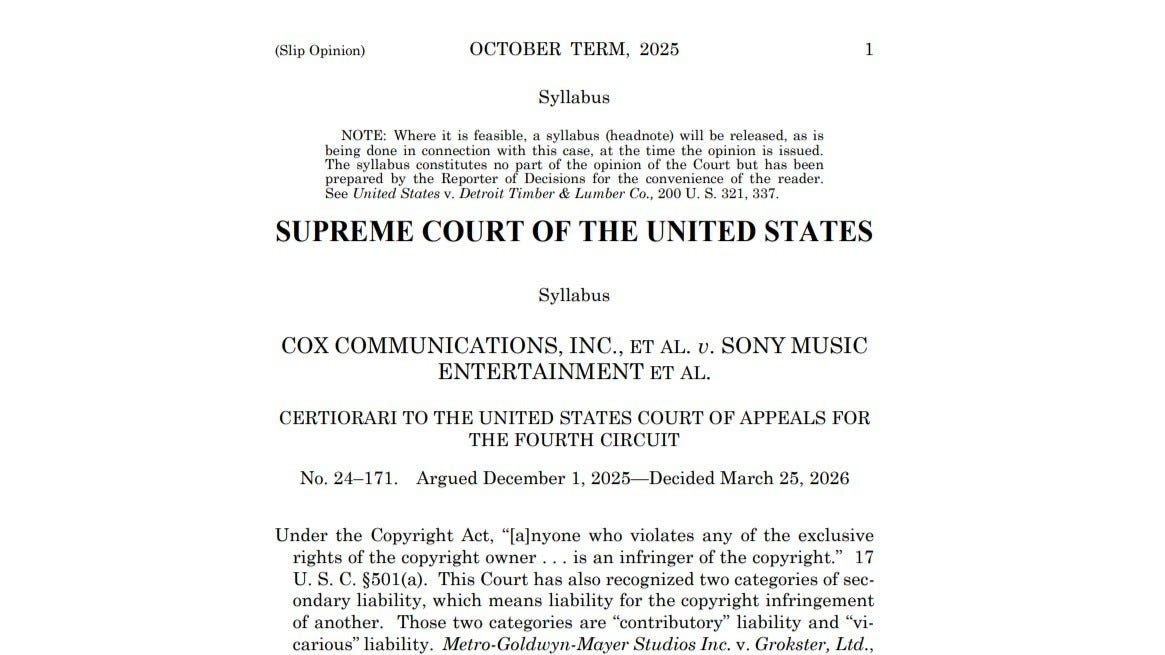
For twenty five years, copyright owners have tried to turn internet service providers into copyright police. The Supreme Court’s unanimous decision in Cox Communications, Inc. v. Sony Music Entertainment re centers the limits on secondary liability in a way that matters to every platform, ISP, rights holder, and tech lawyer reading this. For me, it also closes a personal loop: I first wrote about Sony and Napster in my college honors thesis, and now those same doctrines are back at center stage in a broadband world where dialup era assumptions no longer fit.
Key facts
Cox Communications, Inc. v. Sony Music Entertainment, 607 U.S. ___ (2026), unanimously reverses a billion dollar contributory infringement verdict against Cox over subscriber piracy.
The Court frames contributory liability around intentional facilitation of infringement, with inducement and services effectively tailored to infringing use as the principal pathways to show the required culpable purpose.
The Court rejects the Fourth Circuit’s “knowledge plus continued service” rule, holding that mere knowledge that a service will be used to infringe, combined with failure to terminate users, is insufficient for contributory liability.
The opinion leans on Sony Corp. of Am. v. Universal City Studios, Inc., 464 U.S. 417 (1984), and MGM Studios Inc. v. Grokster, Ltd., 545 U.S. 913 (2005), emphasizing that the Copyright Act does not itself define secondary liability and that courts must stay within established common law limits.
The Court treats services effectively “tailored to infringement” that lack meaningful lawful applications as strong evidence of the requisite intent, rather than a freestanding test divorced from Sony’s substantial noninfringing use analysis.
The DMCA safe harbors in 17 U.S.C. § 512 remain defenses, not duties, and failure to qualify for safe harbor does not by itself create liability, although the DMCA continues to function as a powerful compliance framework structuring provider behavior.
The Court addresses only contributory liability; it expressly leaves vicarious liability untouched, preserving that doctrine as a potential avenue for future intermediary cases.
From Betamax to Napster to fiber
The modern story starts with Sony Corp. of Am. v. Universal City Studios, Inc., where the Court held that Sony was not contributorily liable for users who recorded copyrighted television content using Betamax VCRs. 464 U.S. 417 (1984). The Court announced the core principle for technology cases: a product that is “capable of substantial noninfringing uses” cannot trigger contributory liability based merely on knowledge that some users will infringe. Id. at 442, 456.
Peer to peer file sharing pushed that principle to its limits. In A&M Records, Inc. v. Napster, Inc., the Ninth Circuit held that Napster was contributorily and vicariously liable because it had actual knowledge of specific infringing activity and materially contributed by providing centralized servers and indexing that made the exchanges possible. 239 F.3d 1004, 1013–19 (9th Cir. 2001). Napster became the template for an aggressive litigation campaign against intermediaries that looked less like neutral device makers and more like active hubs for infringement.
Grokster refined the doctrine by recognizing a distinct inducement theory. A distributor is liable where it “distributes a device with the object of promoting its use to infringe copyright,” as shown by clear expressions or affirmative steps to foster infringement. 545 U.S. at 936–37. The software at issue openly targeted former Napster users and celebrated infringing usage, which the Court treated as powerful evidence of an objective to promote infringement.
Congress layered the DMCA on top of this case law. Title II creates safe harbors for “service providers” that, among other things, adopt and reasonably implement policies to terminate “repeat infringers” and respond to compliant takedown notices. 17 U.S.C. § 512(i). Those provisions were drafted for a dialup world in which bandwidth itself limited consumer scale infringement: at 56 kbps, downloading a 3 to 5 megabyte MP3 file could easily take fifteen to twenty minutes, so even a determined user might manage only a handful of songs in an evening.
Today high speed access changes that calculus completely. A 4K feature film encoded at 15 to 25 Mbps can be downloaded in minutes over a gigabit connection, and even 100 Mbps broadband can move the same file in well under an hour. The same doctrines now operate in a universe where any residential connection can move massive volumes of content, which explains the industry pivot from suing individuals to targeting the “pipes.”
The early online enforcement model
In the early 2000s, the recording and motion picture industries pursued an aggressive multi front strategy.
Suing individuals, including the wrong ones. The RIAA sued thousands of individuals based largely on IP addresses observed on peer to peer networks, sometimes with minimal verification. In one widely reported case, a 65 year old Massachusetts grandmother was sued for allegedly sharing over 2,000 songs even though she did not own the computer or file sharing software at issue; the case was later dropped when the error surfaced. Those stories shaped public perception of copyright enforcement for years.
Statutory damages as leverage. Plaintiffs used the threat of statutory damages up to $150,000 per work for willful infringement under 17 U.S.C. § 504(c)(2) to push for mid four figure settlements, effectively offering a choice between paying now or risking ruin. That created deterrence but also a reputational backlash against perceived “shakedown” tactics.
Pressure on ISPs and graduated response regimes. Rights holders leveraged DMCA repeat infringer provisions and contractual leverage to push ISPs to forward notices, throttle traffic, or terminate “repeat offenders” under “three strikes” or “six strikes” programs. In some markets this effectively deputized ISPs as private copyright enforcers based on untested allegations.
The BMG Rights Mgmt. (US) LLC v. Cox Communications, Inc. litigation was a key step in turning DMCA leverage into liability. The Fourth Circuit held that Cox could not invoke safe harbor because its repeat infringer policy was not reasonably implemented and affirmed contributory liability based on continued service to known infringers. 881 F.3d 293, 301–05, 311–12 (4th Cir. 2018). That framework set up the stakes in the subsequent Sony v. Cox trial and the billion dollar verdict the Supreme Court just reversed.
Cox v. Sony: facts, history, and the holding
How the dispute arose
Sony Music and other rightsholders engaged a monitoring vendor to track peer to peer activity and tie specific infringements to Cox subscriber IP addresses, ultimately sending more than 163,000 notices over roughly two years. Rather than sue individual subscribers, Sony sued Cox in the Eastern District of Virginia for secondary copyright infringement on both contributory and vicarious theories.
Sony argued that Cox knowingly continued to provide internet access to subscribers whose IP addresses were repeatedly associated with infringement and that Cox retained the contractual right and practical ability to terminate those accounts. Cox responded that it maintained an acceptable use policy prohibiting infringement, operated a graduated response system with warnings and suspensions, and that its broadband service had overwhelmingly lawful uses.
A jury found Cox liable for both contributory and vicarious infringement, found willfulness, and awarded $1 billion in statutory damages for 10,017 works. Sony Music Ent. v. Cox Commc’ns, Inc., 464 F. Supp. 3d 795, 807–08 (E.D. Va. 2020). The Fourth Circuit reversed as to vicarious liability but affirmed contributory liability under a “knowledge plus continued service” theory. 93 F.4th 222, 233–36 (4th Cir. 2024). The Supreme Court granted certiorari on contributory liability only and denied Sony’s cross petition on vicarious liability.
The reframed contributory standard
Justice Thomas, writing for a unanimous Court, begins by reiterating that the Copyright Act “does not expressly render anyone liable for infringement committed by another,” citing 17 U.S.C. § 501(a) and Sony. The Court recognizes contributory and vicarious liability as distinct common law doctrines and limits its analysis to the former.
The central move is how the Court organizes contributory liability:
Intent centric framing. The Court states that “the provider of a service is contributorily liable for a user’s infringement only if it intended that the provided service be used for infringement,” and then identifies inducement and effectively infringement tailored services as the principal routes to prove that objective. Rather than announcing a rigid taxonomy, the opinion uses these as doctrinally grounded exemplars.
Inducement in the Grokster sense. A provider induces infringement when it affirmatively encourages infringement through concrete acts such as advertising infringing uses or instructing users how to infringe. Nothing in the record showed Cox engaging in that kind of behavior: Cox did not market itself for piracy, did not court infringing communities, and warned and suspended some subscribers.
“Tailored to infringement” as evidence of intent. The Court explains that a service is effectively tailored to infringement when it is not capable of substantial or commercially significant noninfringing uses, echoing Sony’s substantial noninfringing use standard. This is treated as strong evidence of a culpable purpose, not as a free standing test. Cox’s broadband service, by contrast, was capable of substantial lawful use and not designed to promote infringement.
The Court’s reasoning echoes inducement and contributory infringement concepts from patent law, where 35 U.S.C. § 271(b) and (c) similarly focus on intent and lack of substantial noninfringing uses, but the opinion stops short of formally harmonizing the two regimes.
Most importantly, the Court “squarely reject[s]” the Fourth Circuit’s standard that “supplying a product with knowledge that the recipient will use it to infringe copyrights is exactly the sort of culpable conduct sufficient for contributory infringement.” That rule, the Court holds, extends contributory liability beyond Sony and Grokster and conflicts with the repeated admonition that contributory liability cannot rest on knowledge plus insufficient action alone.
Applied to Cox, the result is straightforward. There was no inducement, and Cox’s service was not effectively tailored to infringement. The fact that Cox received hundreds of thousands of notices and did not terminate every associated account did not establish the required culpable purpose.
DMCA safe harbor and the “failure to terminate” theory
Sony argued that if Cox is not contributorily liable on these facts, the DMCA safe harbors in 17 U.S.C. § 512 lose practical force, because ISPs can simply ignore repeat infringer notices without consequence. The Court disagreed. It stressed § 512(l), which provides that failure to qualify for safe harbor “shall not bear adversely upon” a provider’s noninfringement defense. Safe harbors are shields, not floors.
At the same time, the opinion substantially undermines “failure to terminate” as a standalone theory of contributory liability for neutral access providers. Continuing to serve subscribers after receiving infringement notices, without more, does not establish the intent needed for contributory liability. That is a meaningful practical shift, even though the Court presents it as an application of existing doctrine.
The DMCA still matters enormously in practice. Platforms and ISPs are likely to maintain repeat infringer policies and respond to notices to preserve safe harbor protection and manage reputational, regulatory, and policy risk, as well as to mitigate exposure on other theories such as vicarious liability that Cox does not address.
Vicarious liability and the Sotomayor concurrence
For practitioners, it is critical that the Court did not revisit vicarious liability. By granting certiorari only as to contributory liability and denying Sony’s petition on vicarious liability, the Court leaves the Fourth Circuit’s no‑benefit holding in place and vicarious doctrine generally untouched. Plaintiffs can therefore be expected to pivot toward vicarious theories and inducement heavy fact patterns where possible.
Justice Sotomayor, joined by Justice Jackson, concurs in the judgment but warns that the majority “unnecessarily limits secondary liability” and could be read as constraining traditional aiding and abetting style concepts. She emphasizes that contributory infringement historically attaches when a party materially contributes in some way to another’s infringement and worries that lower courts might treat inducement and tailoring as exclusive categories. For now, her opinion functions as a caution against overreading the majority rather than a competing rule.
Old rule vs new reality for ISPs
For in house counsel and litigators, the shift can be summarized as follows:
AspectPre Cox (Fourth Circuit view)Post Cox (Supreme Court view)Baseline standard Knowledge of infringement plus continued provision of service may suffice for contributory liability. Intent to facilitate infringement is required, shown primarily through inducement or services effectively tailored to infringement. Role of repeat infringer notices Large volumes of notices could support “knowledge plus inaction” theories and major damages. Notices alone do not create contributory liability; they still matter for DMCA safe harbor and broader risk management. Failure to terminate Central pillar of plaintiffs’ theories against ISPs. Largely eliminated as a standalone contributory theory for neutral access providers. DMCA safe harbor Often treated as implying duties to terminate repeat infringers to avoid liability. Clarified as a defense, not a duty creating statute, while remaining a powerful compliance and governance framework.
Neutral ISPs are no longer positioned as default copyright police simply because they receive notices. They remain exposed if they design or market services to facilitate piracy or if they fit traditional vicarious criteria, but “knowledge plus continued service” is no longer enough.
Winners, losers, and what to do on Monday
Likely winners
ISPs and infrastructure providers. Fixed and mobile ISPs, cloud hosts, CDNs, and other backbone services gain a clearer, narrower standard for contributory liability focused on culpable purpose rather than the volume of notices. Neutral connectivity and general purpose infrastructure are significantly safer.
AI and emerging tech platforms with substantial lawful uses. Providers of tools with obvious noninfringing applications can rely on the Sony/Grokster/Cox line to argue that absent inducement or designs that are effectively good for nothing but infringement, secondary liability should not attach.
Consumers and digital rights advocates. Groups like Public Knowledge have applauded the decision as protecting ordinary users from losing essential connectivity based on untested allegations.
Likely losers
Major music and film rightsholders. The plaintiffs in Cox and similarly situated entities lose a potent leverage theory against deep pocket intermediaries that continue serving alleged repeat infringers. Future cases will need to focus on direct infringers, inducement heavy platforms, or legislative change.
Anti piracy vendors built on notice volume. Business models premised on sending massive numbers of notices and then using resulting “knowledge” as the backbone for contributory suits against conduits lose substantial doctrinal force. The value proposition shifts toward precision in detection and evidence of intent, not just scale.
Best practices for rights holders and service providers
For copyright holders and their counsel
Prioritize defendants with culpable purpose.
Use the DMCA as a framework, not a liability hook.
Calibrate damages and settlement posture.
Develop inducement evidence where merited.
Engage in policy and standards work.
For ISPs, platforms, and online services
Maintain clear policies and document implementation.
Avoid inducement signals in marketing and product design.
Design for substantial lawful use.
Treat the DMCA as governance infrastructure.
Monitor the vicarious liability front.
Key takeaways
Cox v. Sony re centers contributory liability around culpable purpose, treating inducement and services effectively tailored to infringement as the principal, doctrine grounded pathways to show that purpose, and rejects “knowledge plus continued service” as sufficient.
The opinion largely eliminates failure to terminate subscribers as a standalone contributory theory for neutral ISPs, even as many providers will maintain repeat infringer policies to preserve DMCA safe harbor and manage broader risk.
The DMCA is confirmed as a shield rather than a source of affirmative duties, but it remains a powerful compliance and governance framework that shapes how providers handle infringement allegations in practice. 17 U.S.C. § 512(l).
Vicarious liability and inducement heavy fact patterns remain live battlegrounds. Plaintiffs are likely to pivot there, while defendants will emphasize substantial lawful uses, neutral design, and non inducement as core defenses.
For in house counsel, litigators, and tech and media executives, Cox offers both a doctrinal anchor and a practical roadmap for building and defending services in a world where gigabit connections make infringement effortless but courts remain reluctant to conscript the pipes as copyright police.