Held Hostage By SAVE
Why Public Servants Should Wait Before Leaving The Plan

Most people think student loans are about numbers. In reality they are about power. The Department of Education can change repayment rules midstream, send confusing notices that push borrowers toward “voluntary” changes, and then argue in court that those borrowers waived their rights. That is exactly what is happening right now with the end of the SAVE plan, the treatment of REPAYE, and the public servants stuck in involuntary forbearance while they wait for the promise of Public Service Loan Forgiveness (PSLF) to be honored. This article is about the current injunction fight, and it uses my own experience and the history of PSLF to explain why, for many borrowers, the most rational move right now is to wait.
Key facts
PSLF was created by Congress in 2007 with authority under the Higher Education Act and is implemented in 34 C.F.R. § 685.219. It forgives remaining Direct Loan balances after a borrower makes 120 qualifying monthly payments on or after October 1 2007 while working full time for a qualifying public service employer, and under current law PSLF forgiveness itself is not treated as taxable income.
REPAYE was established in 2015 as a broad income driven plan through negotiated rulemaking. It allowed most Direct Loan borrowers to enroll and offered strong interest subsidies, with 20 year forgiveness for undergraduate borrowers and 25 year forgiveness for graduate borrowers.
SAVE was adopted as an enhancement and rebrand of REPAYE. Plaintiffs in current litigation contend that when SAVE’s Final Rule was vacated by the Eighth Circuit, the prior REPAYE regulations were restored by operation of law, while the Department has not made REPAYE available for borrower enrollment despite those regulations not having been formally repealed.
After SAVE was halted, borrowers already in SAVE were placed into administrative forbearance. The Department later announced that servicers would, around July 1, begin sending notices giving borrowers at least 90 days from the date their own servicer contacts them to select a new plan before any automatic placement into Standard or Tiered Standard plans, meaning July 1 is the start of a process, not the borrowers’ decision deadline.
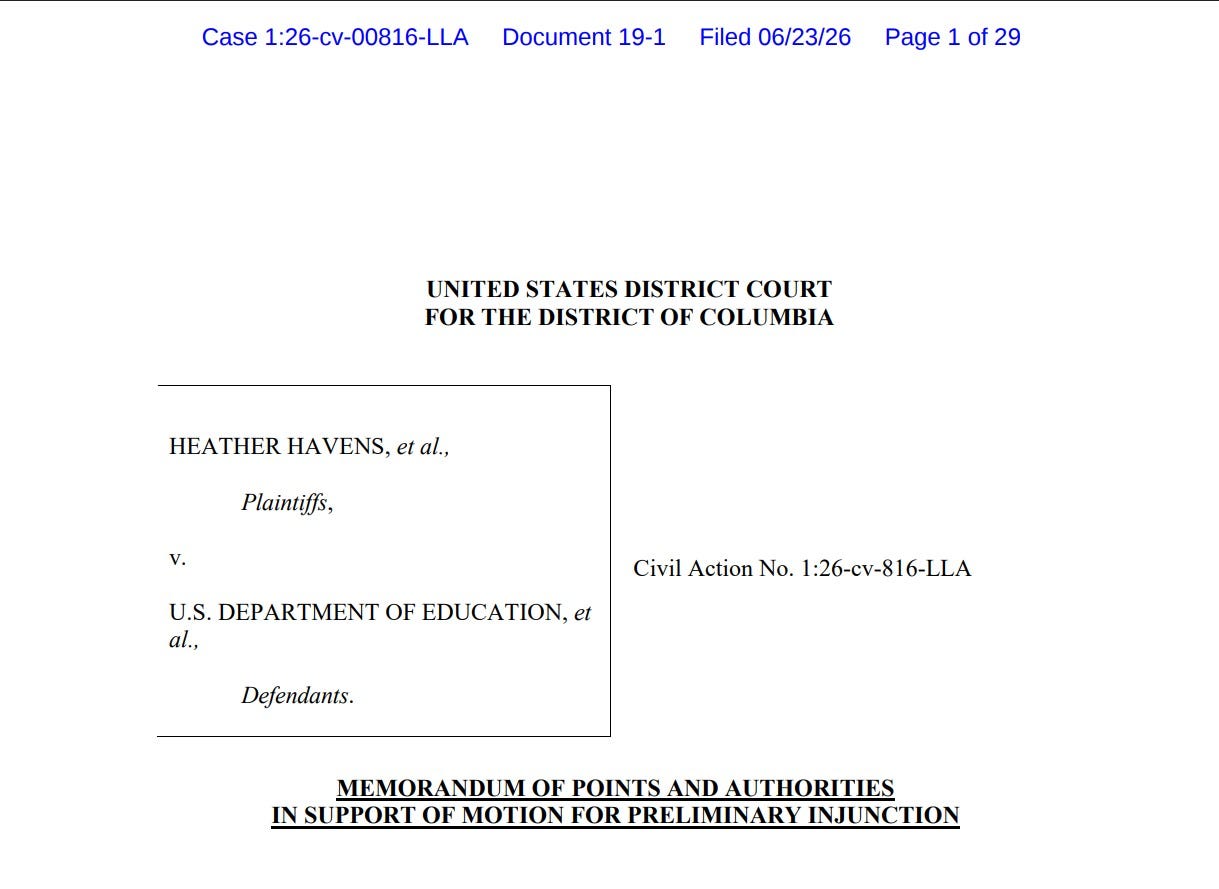
An amended complaint and motion for preliminary injunction filed by Public Goods Practice LLP argue that the Department’s “shadow repeal” of REPAYE, forced transfers, and failure to process forgiveness violate the Administrative Procedure Act (APA), exceed statutory authority, and disregard reliance interests. The motion asks the court to stop the forced transfer out of SAVE and to require the Department to make REPAYE available again while the lawsuit proceeds.
When Even Ivy League Lawyers Are Confused
Over the last few weeks, my phone has been busy. Friends and colleagues call when they need to untangle legal issues in their own lives, with their clients, or inside their agencies. One of those calls came from a government lawyer who had spent years as a state prosecutor and now works in federal service. He and his wife had just received one of the Department of Education emails about SAVE and an apparent July 1 deadline.
The email was word salad. Dates, bold text, and headings were arranged so that “July 1” sat in the middle of warnings about being moved into a more expensive plan. The deadline was bolded, the 90 day window was buried, and the sequencing made it easy to read the message as “act by July 1 or face higher payments.” Even an Ivy League–educated attorney looked at it and reasonably concluded he had to act immediately.
I had received the same notice. I did what lawyers are trained to do when language looks like pressure. I read every clause. The critical detail was not July 1 itself. The Department’s own guidance and subsequent reporting showed that servicers would begin contacting borrowers on or around July 1, and that borrowers would then have at least 90 days from the date their own servicer reaches out to choose a new plan before any automatic assignment would occur. July 1 is the start of the notification process, not the day borrowers must decide. In my view, the way the notice was structured made this genuinely hard to see. The bold date created urgency. The actual legal timeline sat in smaller type.
I told my friend two things. First, do not switch plans based on that email alone. Second, someone would file suit and seek an injunction to block these forced transfers. If nobody else did it, I would.
Days later, Public Goods Practice filed a motion that said almost exactly what I had told him months earlier, and they grounded it squarely in the APA.
PSLF: A Reliance-Based Bargain, Not A Favor
PSLF is often described as a program. I think of it as a statutory bargain with contractual features. In 2007, Congress used its authority under Title IV of the Higher Education Act to direct the Secretary of Education to offer PSLF. The implementing regulation, 34 C.F.R. § 685.219, sets out the terms: 120 qualifying monthly payments on eligible Direct Loans after October 1 2007, made while working full time for a qualifying government or nonprofit employer.
Borrowers did not merely select a repayment plan. Many chose government service over private sector salaries, delayed home purchases, accepted lower lifetime earnings, and built long term financial plans around the expectation that PSLF would be available after 120 qualifying payments. That is reliance in the classic sense. Although arising in different factual contexts, cases like Perry v. Sindermann, 408 U.S. 593 (1972), and Lynch v. United States, 292 U.S. 571 (1934), recognize that government assurances and contracts can create legitimate expectations and legally protected interests even when they do not look like traditional private agreements. More recently, the Supreme Court has made clear that when agencies change policy, they must explain how they are treating reliance interests and why any disruption is justified, see Dep’t of Homeland Sec. v. Regents of the Univ. of Cal., 591 U.S. 1 (2020).
For lawyers, the economics are not theoretical. Large firms with more than 700 lawyers report starting salaries around $215,000. Firms with 100 or fewer lawyers report starting salaries closer to $155,000. Public salary surveys show average associate attorney pay in New York State around $149,501. By contrast, entry level federal and state government attorney salaries often sit in the $70,000–$100,000 range depending on grade and locality. For a lawyer carrying six figure student debt, the difference between $80,000 and $215,000 per year is the difference between a path to pay the loans and long term financial strain.
PSLF is what makes that public service choice financially rational. It is a reliance-based promise backed by statute and regulation. PSLF forgiveness remains non-taxable under current law, which gives it special weight compared to many other forms of discharge. If a borrower works 119 months instead of 120, they receive nothing. That is why the treatment of SAVE forbearance months, and any attempt to change the finish line after the race has begun, is so serious.
The Shadow Tax On Education
The student loan system, taken as a whole, functions like a shadow tax on middle class access to education. Wealthy families can often pay the full cost of tuition without borrowing. Lower income students may obtain grants and scholarships that significantly reduce loan needs. Many middle class families fall in between. They earn too much to qualify for maximum aid and too little to pay $90,000 per year in cash.
Brown University makes this concrete, and for me, personal. For 2025–26 Brown lists undergraduate tuition at $35,850 per semester, $71,700 per year, with required fees around $2,950, housing around $10,410 and food around $8,104. Once you add books, travel and personal costs, total annual cost can approach or exceed $95,000. At schools like Washington University School of Law, annual cost of attendance commonly surpasses $90,000, making a three year law degree a roughly $250,000 commitment.
These costs are financed largely by federal student loans. Outstanding federal student loan balances stand around $1.66T–$1.69T, depending on the quarter and source, and total student loan debt including private loans is closer to $1.86T. For loans issued in 2026–27, federal rates are 6.52% for undergraduate Direct loans, 8.07% for graduate Direct loans and 9.07% for PLUS loans. Since 2013 those rates have been set using the 10 year Treasury yield plus fixed add ons.
The interest is the shadow tax. Over decades it compounds. Borrowers in high paying private practice can absorb that cost. Public servants on government salaries often cannot. They pay a long term financing charge to the federal government for the privilege of obtaining an education and serving the public. Wealthier students who can pay upfront do not pay that charge.
PSLF and income driven plans were supposed to mitigate that tax for people who chose service over salary. That makes the current SAVE and REPAYE dispute more than a technical rule fight. It raises the question whether public servants can trust the promises that led them into public service in the first place.
REPAYE, SAVE, And The Administrative Forbearance Trap
REPAYE was introduced in 2015 via regulation as a broad income driven plan. It expanded eligibility beyond earlier plans and provided strong interest subsidies. For the first three years of negative amortization, the government covered 100% of unpaid interest. After that it covered 50%, limiting balance growth even when payments were low. REPAYE offered forgiveness after 20 years of qualifying payments for undergraduate borrowers and 25 years for graduate borrowers. Millions of borrowers enrolled, including many working toward PSLF.
The Department later adopted SAVE as its redesign of REPAYE. SAVE lowered payments, protected more income, and improved terms, making it, in the Department’s own words, “the most affordable repayment plan ever created”. Borrowers in REPAYE were converted into SAVE. Others enrolled directly. Separately, the Department created the PSLF Buyback program, which allows borrowers to “buy back” certain past periods of forbearance or deferment by paying an amount equal to their current monthly payment so that those months are counted toward the 120 PSLF payments. That buyback mechanism is part of PSLF administration rather than a feature written into the SAVE regulation itself, but it became crucial once administrative forbearance was imposed.
Then litigation began. A coalition of Republican-led states challenged SAVE, arguing that it exceeded statutory authority and imposed unlawful burdens on state-linked entities. The Eighth Circuit ultimately vacated key portions of the SAVE Final Rule. Plaintiffs in Havens argue that vacating SAVE’s amendments means the prior REPAYE regulations were restored by operation of law, while the Department has not made REPAYE available for borrower enrollment despite the underlying regulations not having been formally repealed. The Department, for its part, disputes many of these allegations and argues that its actions are required by the Eighth Circuit’s decision and subsequent statutory changes.
In the meantime, borrowers already enrolled in SAVE were placed into administrative forbearance. No payments were due, and interest accrual rules were adjusted, but borrowers could not simply choose to continue under SAVE as if nothing had changed. For PSLF purposes, those forbearance months have generally not been counted as qualifying payments unless later credited through buyback or other special provisions. Processing of buyback and plan changes has been significantly delayed, with many borrowers waiting months for their choices to be implemented. Many wanted to exit the limbo. In practice, there was no quick way out.
That stands in sharp contrast to COVID. Under the CARES Act, months in the automatic payment pause counted toward PSLF as long as borrowers remained in qualifying employment. Congress expressly authorized that treatment. The SAVE administrative forbearance arose under different legal circumstances, but the difference in how the Department treats those months is stark. In one context, a payment pause supported borrowers. In the other, it left their progress frozen.
For borrowers near their 120th qualifying payment, the mid 2025 freeze created more than inconvenience. Some had less than a year of payments left. Over the past year, they continued working in public service. Yet those months did not move them closer to PSLF unless and until buyback was processed, and buyback processing itself has been slow in an understaffed agency. They could not confidently leave public service because their 120 payments were stalled. They felt stuck at mile 26 with the marathon finish line quietly pushed farther away.
July Notices And The Risk Of “Voluntary” Waivers
This is the backdrop in which the July notices arrived. In March 2026, the Department announced that loan servicers would begin sending notices to SAVE borrowers around July 1. Those notices would explain that borrowers had at least 90 days from the date their own servicer contacts them to select a new repayment plan before being automatically placed into the Standard or Tiered Standard plan. Standard repayment, typically a 10-year schedule, often produces substantially higher monthly payments than income driven plans, even though payments under Standard can still qualify for PSLF if they are otherwise eligible and made on time. Tiered Standard similarly tends to increase payments over time.
The wording and formatting of the notices matter. The bolded July 1 date, the placement of warnings above the explanation of the 90 day window, and the emphasis on higher payments all work together to imply urgency. For someone who has not spent years reading federal regulations, it is entirely reasonable to misread the email as “you must act by July 1.” That is exactly what happened to my friend.
In my view, the structure of these notices appears designed to encourage borrowers to voluntarily leave SAVE before any automatic transfer occurs. Critics argue that this is not a neutral communication but an attempt to turn an involuntary transition into a formally voluntary choice. If a borrower clicks through and selects a new plan, the Department can later argue in court that the borrower was not coerced, that the notice presented options, and that any subsequent harm flows from that voluntary selection rather than from unlawful agency conduct, although whether courts will ultimately accept that argument is a separate question.
This is the distinction between an involuntary transition and a voluntary selection. An involuntary transition occurs when the agency moves borrowers because its policy changes. A voluntary selection occurs when a borrower affirmatively chooses a new plan. Voluntary choices are often treated as waivers or cures of prior problems. They can be much harder to challenge later.
That is why I told my friend not to switch plans yet. Staying put preserves arguments about coercion, statutory obligations, and reliance interests. It keeps you in the group whose treatment is being litigated. Switching now makes it easier for the government to say “you agreed” and harder to argue that you were forced.
The Public Goods Practice Lawsuit And Motion
On June 23 2026, Public Goods Practice LLP filed an amended complaint and a motion for preliminary injunction in Havens v. U.S. Department of Education. The lawsuit is now the main vehicle for challenging the Department’s approach to SAVE, REPAYE, and forced transfers.
The plaintiffs assert three core claims.
First, they allege that the Department has engaged in a “shadow repeal” of REPAYE. When the SAVE amendments were vacated, plaintiffs contend the prior REPAYE regulations were restored by operation of law. Instead of administering REPAYE, the Department removed it from IDR request forms, from the loan simulator, and from its public guidance, while new rules still refer to a future REPAYE sunset date that presumes the plan currently exists. Plaintiffs say this is a repeal or suspension of a rule without the notice and comment procedures required by 20 U.S.C. § 1098a and 5 U.S.C. § 553.
Second, they challenge the Department’s plan to force borrowers into different repayment options. The Higher Education Act allows the Secretary to establish repayment plans by regulation and generally allows borrowers to choose among eligible plans, subject to limited exceptions. Plaintiffs maintain that involuntarily moving borrowers who lawfully enrolled in REPAYE/SAVE into more expensive plans, while refusing to administer REPAYE, exceeds statutory authority and contradicts the regulatory framework that protects borrower choice.
Third, they focus on the Department’s failure to process forgiveness and the tax consequences of delayed discharge. The American Rescue Plan Act provided that many student loan discharges between 2021 and 2025 would not be taxable income under 26 U.S.C. § 108(f)(5). That temporary protection expired on January 1 2026. PSLF forgiveness remains tax free under separate authority, but other IDR discharges can be taxable if they occur after the ARPA window closes. Plaintiffs point out that the Department has duties to process discharges in a timely manner and that courts, including in American Federation of Teachers v. U.S. Department of Education, have held that the legal discharge date, not the date a letter is printed, controls for tax purposes. By delaying discharges that should have occurred under SAVE or REPAYE, pushing some borrowers into new plans, and moving discharge dates into 2026, the Department is arguably exposing borrowers to tax burdens they should not bear.
Reliance interests matter here because agencies changing policy must explain why those interests are outweighed and why the new policy is justified despite the disruption it causes. Under the APA, 5 U.S.C. § 706(2)(A), courts must set aside agency actions that are arbitrary, capricious, an abuse of discretion, or otherwise not in accordance with law. The Supreme Court has explained that an agency must consider relevant factors and articulate a rational connection between facts and policy choices. Failure to consider important aspects of the problem or reliance interests can render action arbitrary and capricious, see Motor Vehicle Mfrs. Ass’n of the U.S., Inc. v. State Farm Mut. Auto. Ins. Co., 463 U.S. 29 (1983). The motion also cites 5 U.S.C. § 706(2)(C) for actions exceeding statutory authority, § 706(2)(D) for rule changes made without required procedures, and § 706(1) for agency action unlawfully withheld or unreasonably delayed, specifically the failure to administer REPAYE and process discharges.
Plaintiffs additionally ask the court under 5 U.S.C. § 705 to postpone the effective date of the Department’s forced transfer policy, which would halt automatic moves out of SAVE while the case is adjudicated. If granted, that relief would protect more than just the named plaintiffs.
A Broader Pattern: APA Challenges And Attrition
This SAVE/REPAYE litigation is not the only student loan policy from this administration facing APA scrutiny.
In June 2026, a federal judge blocked part of a Trump administration plan that would limit graduate student borrowing in fields like nursing, physical therapy and public health. The One Big Beautiful Bill Act established new federal borrowing caps set to take effect July 1 2026, but the court concluded that at least some of these restrictions were likely unlawful and would harm the future health care workforce. That case is distinct from the SAVE litigation, yet it fits a broader pattern: aggressive policy changes, legally fragile foundations, and reliance on the APA as a check.
Within the SAVE context, the PSLF Buyback program illustrates another pressure point. In theory, buyback allows borrowers to pay an amount equal to their current monthly payment for specific past months, thereby converting those months into qualifying PSLF time. In practice, reports note that tens of thousands of borrowers are stuck in buyback backlogs and hundreds of thousands are waiting on IDR enrollments to be processed, all while Federal Student Aid staffing has been sharply reduced. Borrowers are told they can repair the damage that forbearance did to their PSLF timeline. Operationally, many cannot.
Taken together, these examples show a pattern: complex policy moves that invite APA challenges, confusion in communications, and heavy reliance on process and delay. Many borrowers eventually give up and accept less than what the law arguably entitles them to because the fight is exhausting and the government can litigate indefinitely.
Why Waiting Can Be The Most Rational Choice
For public servants in SAVE or REPAYE who are working toward PSLF, especially those near the 120 payment mark, the practical question is what to do now.
In my view, the safest course for many such borrowers is to wait and see what the court does before voluntarily changing plans in response to the July notices. If you remain in SAVE and are later moved by agency policy, that transition is involuntary and sits squarely within what Havens is challenging. Your reliance on PSLF and income driven rules remains intact, and you can point to agency action as the source of any harm.
If you proactively select a new plan now, you create a voluntary selection record. The Department will likely argue that you were not forced, that you made an informed choice after receiving a notice, and that any subsequent harm flows from that voluntary selection rather than from unlawful conduct. Whether courts will accept that argument is uncertain, but it plainly complicates the legal picture.
None of this is legal advice. Individual circumstances differ, particularly for borrowers whose loans are not eligible for PSLF or who are approaching other forgiveness deadlines. It is legal analysis based on current facts and litigation. In my view, the Department has attempted to change the practical terms under which borrowers receive promised benefits, after many have already performed the public service that PSLF demands. Changing the repayment rules after borrowers have nearly completed ten years of service is like moving the finish line while the race is underway. The outcome of Havens will help decide whether that is permissible.
Whether borrowers ultimately prevail remains for the courts to decide. But the outcome will affect far more than the future of one repayment plan. It will determine whether public servants can rely on promises made by the federal government when they choose lower-paying careers in service to the public.
Key takeaways
PSLF is a statutory, reliance-based bargain backed by regulation, not a discretionary favor, and PSLF forgiveness remains tax free under current law.
REPAYE and SAVE provided structured paths to manageable payments and eventual forgiveness. Plaintiffs contend that vacating SAVE should have restored REPAYE, but the Department has not made REPAYE available for borrower enrollment despite the underlying regulations not having been formally repealed.
SAVE borrowers were placed into administrative forbearance that did not generally count toward PSLF, unlike COVID-era forbearance, making the current treatment look arbitrary and inviting APA scrutiny.
The Havens lawsuit and Public Goods Practice motion assert that the Department’s “shadow repeal” of REPAYE, forced transfers, and delayed discharges violate multiple APA provisions and disregard borrower reliance interests, while the Department argues its actions are required by court orders and statutes.
For many SAVE and REPAYE borrowers, especially those close to PSLF forgiveness, staying put and watching how the court rules before making any voluntary plan changes may better preserve their legal position than reacting quickly to confusing July notices.